


Sensory Activities to Improve Social Skills in Kids with Autism
6 min read
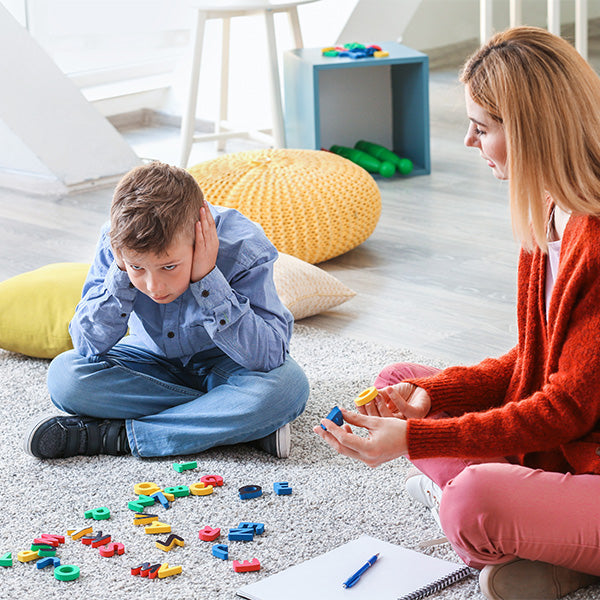
Not everyone is born knowing how to socialize. We usually learn social rules by observing our family and surroundings, but understanding how to interpret social cues can be tricky. Most people eventually understand these cues, but for those with neurological challenges like autism it can be particularly difficult to perceive facial expressions, understand social norms and regulate emotions.
Sensory activities can be particularly effective in helping children with autism develop essential social skills. By engaging their senses children can learn body control, how to greet people and good table manners. Here are some sensory activities that can help improve these skills in kids with autism, along with some helpful tools to enhance the experience.
Body Control
Many kids with autism have poor proprioception (body maps). The reduced ability to feel where their body is in space can make them clumsy. Additionally, they may have extraneous movements that are not appropriate in some social situations. Here are several activities that can improve proprioception and body control.
1. Obstacle Courses
Navigating an obstacle course helps children understand their body's position in space. Set up a simple obstacle course with items like Spot Markers, chairs and tunnels. Add an extra challenge with balance beams or Balance Stepping Stones. As you guide your child through it, encouraging them to crawl, jump and balance, they can work on increasing body awareness.


2. Yoga and Stretching
The intentional movements in yoga improves muscle control as well. Introduce basic poses like the tree pose and child’s pose. Lay out a yoga mat or use a yoga ball and the activities on our Yoga Deck. Incorporating Stretch Bands can enhance the stretching experience by providing resistance input.


3. Dance Parties!
Aside from being fun, dancing enhances coordination and rhythm. Play your child’s favorite music and dance together. Encourage them to follow your movements and create their own. Tossing, catching and twirling Hand-Eye Coordination Scarves can make the activity more engaging and visually stimulating.

4. Stimming Tools
Hand flapping, nail biting, chewing and rocking are stimming behaviors that can act as sensory filters. However, they are not always socially appropriate; as your children get older it may become more challenging to "fit in" with these behaviors. Many sensory tools offer input that can serve as an alternative for your child to use when they need to stim. Providing fidgets, chewies and other such tools can satisfy their need and help them feel more at ease in social settings.


Greeting People
Though it might seem simple enough to just say hello, not everyone can. Here are some tips on how to encourage “proper” communication for your child.
1. Role-Playing Games
Role-playing helps children practice social interactions in a controlled environment. Use puppets or dolls to act out greeting scenarios. Take turns playing different roles your child might encounter, like a friend, teacher or family member. Then let them practice things like opening the door or picking up the phone while you are in your “role” on the other side.

2. Mirror Play
Watching themselves in the mirror can help children understand facial expressions and body language. Stand in front of a mirror and practice greeting gestures, such as waving or shaking hands. Make it fun by adding silly faces and exaggerated movements. As your child’s ability to recognize different expressions improves, you can work on more nuanced motions and facial expressions.

3. Social Stories
Social stories are a great way to provide clear examples of social interactions. Look for stories to read (or create your own!) that are about meeting and greeting people in a variety of settings. Depending on your child’s level of understanding, use simpler or more nuanced language and images to illustrate each step of the greeting process. Storyboards with visual aids can be particularly helpful in this activity.

Table Manners
We hope that when we exercise good table manners that our kids are going to pick up the learned skill. However, many children with autism need to be taught table manners more explicitly than just from modeling. Here are several ways you can teach table manners.
1. Cooking Together
Cooking teaches patience, following instructions and appropriate table behavior. Choose simple recipes and involve your child in the food preparation. Discuss table manners as you cook, such as waiting for everyone to be seated before eating, chewing slowly and asking for items to be passed rather than reaching across others. Including your child in meal prep can also make them more likely to eat the food!

2. Dining Role-Play
Role-playing at the table helps reinforce proper behavior. Set up a pretend restaurant at home and take turns being the server and the diner. Practice ordering food, using utensils correctly, and saying "please" and "thank you." Use this as an opportunity to experiment with sensory tools to increase calm and reduce restlessness for your child, such as weighted lap pads.

Understanding Emotions
While you might know right away that your child had a hard day at school by the way they slam the door when they get home, for a child with autism the cues are not so obvious. Even facial expressions may not immediately trigger an appropriate response. There are ways to move the needle closer to empathy and understanding.
1. Emotion Cards
Visual tools, like the Emoji Emotions Cards, can help children recognize different emotions. Show your child cards with various facial expressions and discuss what each one means. Practice making these faces together to build emotional awareness.


2. Sensory Bottles
Reaching a state of sensory equilibrium is important to be able to reflect on your emotions. Give your child a Calm Down Jar to encourage self-regulation and reflection. Shake the bottle up and watch the glitter settle while taking slow, deep breaths. Use this time to talk with your child about how they are feeling and appropriate ways to manage their emotions.


3. Emotional Thermometers
An emotional thermometer is a visual tool that can help children gauge their feelings. Create a thermometer chart with colors representing different emotions, ranging from calm to very upset. Encourage your child to point to the color that matches their current emotion as a jumping off point for discussion. This is especially helpful if your child cannot yet articulate how they feel, so that you can use the best strategy to support them.
4. Role-Playing Scenarios
Role-playing different scenarios can help children practice responding to others’ emotions. Use toys or puppets to act out situations that elicit various feelings such as happiness, sadness or anger. Discuss appropriate responses and coping strategies. These games are a great way to allow your child space to learn and experiment, without the stress of real-time situations.
Using these ideas to improve social skills in children with autism can make learning these skills fun and effective. Improved body control, knowing how to greet people and appropriate table manners are just some of the ways you can help your child navigate social situations with confidence. The underlying skills that they learn in each of these scenarios will carry over into a wide range of social situations, too.
Not sure what tools can help your child? Explore our range of toys and tools to support those with social-emotional challenges!


Leave a comment